Companies that outsource their lead generation grow their pipelines 43% faster than those relying solely on in-house teams, according to a 2023 Demand Gen Report benchmark study. If you are still building leads entirely on your own, you are almost certainly leaving money on the table.
This guide covers everything you need to know about lead generation services: what they are, how different models work, what separates the good providers from the mediocre ones, and how to match the right approach to your business size, budget, and goals.
TL;DR Summary
- Lead generation services help businesses find and qualify potential customers so sales teams can close deals instead of chasing cold contacts.
- The major service models are retainer-based, pay per lead, pay per appointment, and white label. Each has different risk profiles and cost structures.
- Small businesses usually need more flexible, affordable options. Enterprise teams need volume and deep CRM integration.
- The “best” provider depends on your industry, average deal size, and how much pipeline control you want to retain.
- Pricing ranges widely: pay-per-lead models can cost $20 to $500+ per lead depending on industry and qualification depth.
- Vetting matters. A weak provider wastes your sales team’s time on junk leads, which costs more than the service fee.
What Lead Generation Services Actually Do (And What They Don’t)
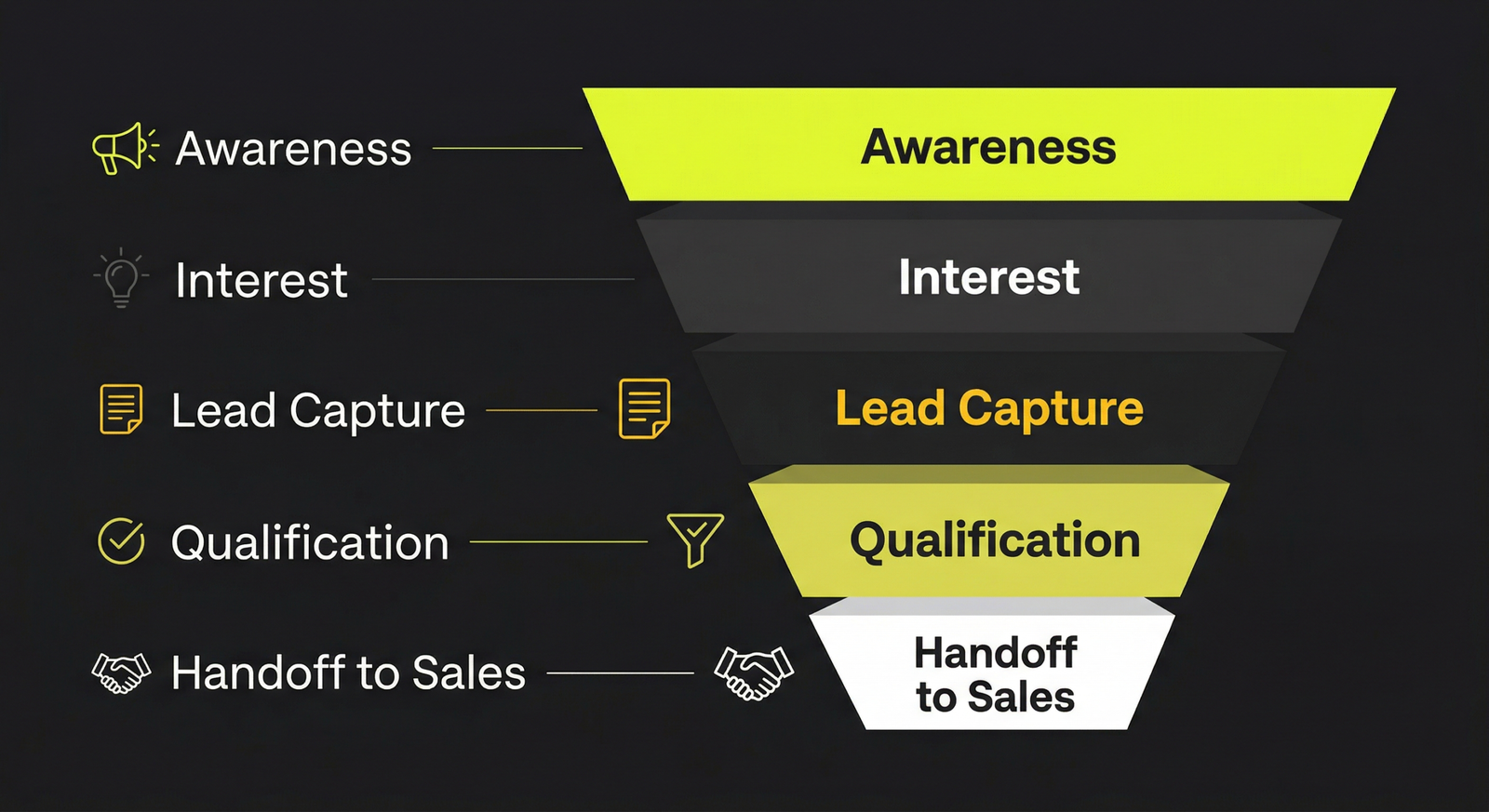
Let’s get this out of the way first. Lead generation services do not close deals for you. They identify, attract, and qualify people or businesses who have shown some interest in what you sell, then pass those contacts to your sales team.
The deliverable varies by provider. Some hand you a spreadsheet of names and emails. Others run multi-touch outreach campaigns and only deliver contacts who have responded positively. The best providers in the market today deliver contacts who have already agreed to a conversation, which is where appointment setting comes in.
There is a meaningful difference between raw lead volume and qualified pipeline. A provider sending you 500 leads a month sounds impressive until you find out your sales team is closing 0.3% of them. A different provider sends 80 leads, but 12% close. The math on the second scenario is better every time.
Demand Gen Report 2026 Benchmark Study →
5 Main Types of Lead Generation Services
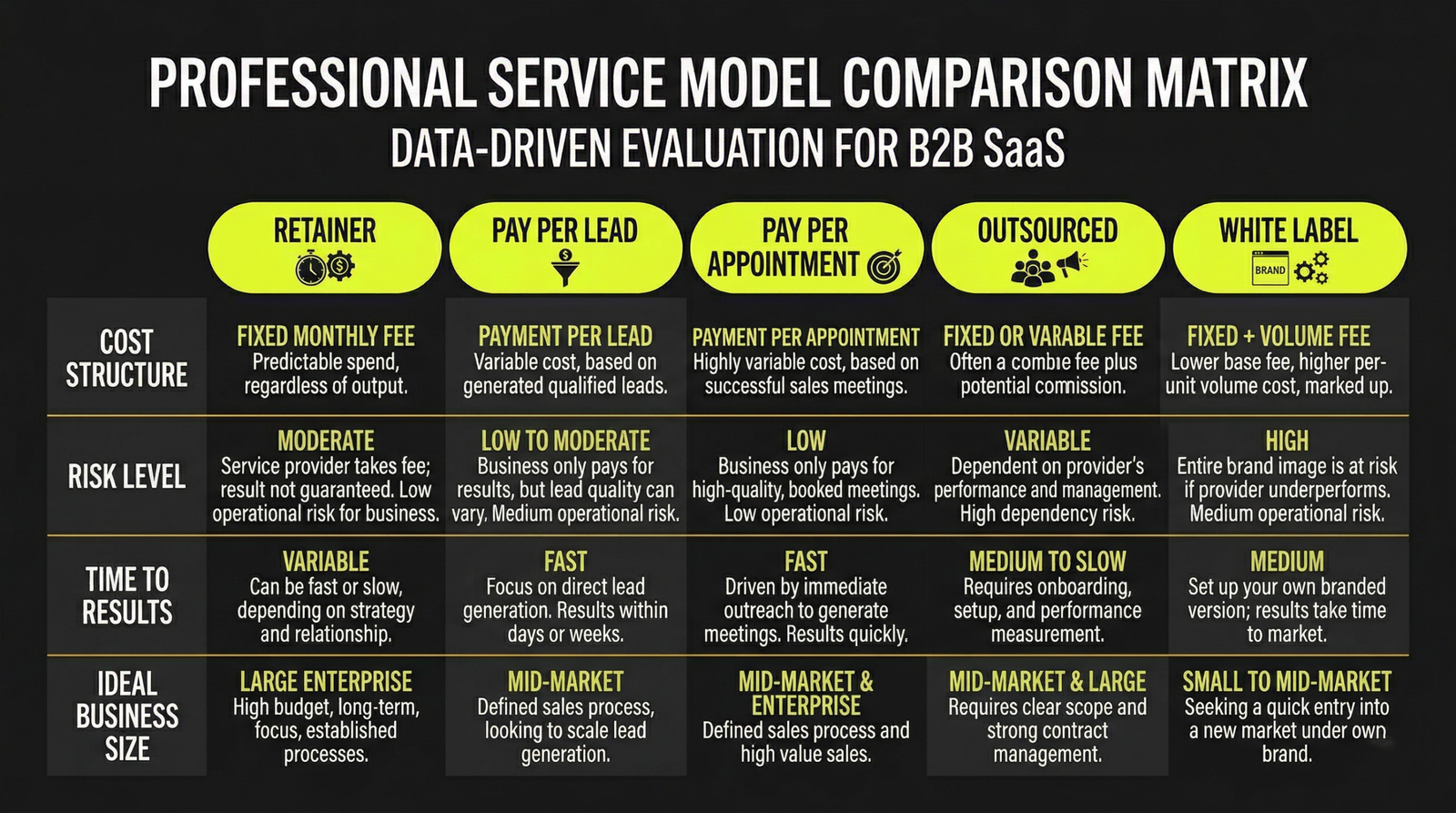
Understanding the service model before you sign a contract is non-negotiable. Here is how each model works, who it suits, and where it breaks down.
1. Retainer-Based Lead Generation
You pay a monthly fee for an agency or team to run campaigns on your behalf. This usually includes strategy, content creation, outreach, list building, and reporting. The agency is paid regardless of results, though most contracts define baseline deliverables.
This model works well for companies that want to build a repeatable system rather than buy individual leads. The downside is that it takes time to see results. Most retainer engagements take 60 to 90 days to build momentum.
2. Pay Per Lead Generation Companies
With this model, you only pay when a lead meets a pre-agreed definition of “qualified.” That definition is usually based on criteria like job title, company size, industry, and whether the contact has expressed interest in your product.
Pay per lead generation companies typically charge anywhere from $20 for a B2C name-and-email lead to $400 or more for a verified, B2B decision-maker lead in a niche industry. The attraction is obvious: you only pay for output. The risk is equally obvious: providers can game the definition of “qualified” if the contract is vague.
Before signing with any pay per lead agency, define exactly what a qualified lead means in writing. What seniority level? What company size? What action did the lead take? Without that, disputes are inevitable.
3. Pay Per Appointment Lead Generation
This is a step further than pay per lead. You pay only when a lead agrees to a live meeting, demo, or phone call with your sales team. The lead generation company handles all the outreach, follow-up, and scheduling.
Pay per appointment lead generation is popular with B2B sales teams selling products or services with longer sales cycles, where getting a real conversation is genuinely difficult. Costs per appointment typically range from $150 to $600 depending on industry.
The model transfers significant risk to the provider, which is why not all agencies offer it. Those that do tend to be more selective about which clients they work with, because they only get paid if they can book meetings.
4. Outsourced Lead Generation Teams
Some companies do not want to manage a lead generation function internally at all. They contract an external team to handle everything: strategy, tooling, outreach, qualification, and handoff. This is full outsourced lead generation.
This approach is common among fast-growing startups that need pipeline immediately and cannot wait to hire and train a full internal team, and among mid-market companies that want to test a new market without committing headcount.
Book a B2B consultation to discuss outsourced lead generation →
5. White Label Lead Generation
White label lead generation is built for agencies rather than end clients. A marketing or sales agency buys lead generation capacity from a specialist provider and resells it under their own brand.
If you run a digital marketing agency and your clients ask for lead generation but you do not have that capability in-house, white label partnerships let you fulfill those requests without building the infrastructure yourself. The white label provider does the work; your agency takes credit.
63% of Marketers Say Generating Traffic and Leads Is Their Top Challenge
HubSpot’s annual State of Marketing report consistently finds lead generation at the top of the challenge list for marketing teams. That number has stayed above 60% for several years running. It is not that companies do not understand the need for leads; it is that executing consistently is genuinely hard.
This is why the market for lead generation companies has grown substantially. The global marketing automation market (which heavily overlaps with lead generation tooling) was valued at $5.2 billion in 2022 and is projected to reach $9.5 billion by 2027, according to Statista.
The problem is that more providers entering the market does not automatically mean better quality. It means more noise. Knowing how to evaluate lead gen companies matters more now than it did five years ago.
How to Evaluate Lead Generation Companies: 7 Factors That Actually Matter
Most buyers focus on price first. That is backwards. A cheap provider who delivers low-quality leads will cost your business far more in wasted sales time than a premium provider who delivers fewer but better-qualified contacts.
Here is what to look at instead.
Industry Specialization
A company that specializes in commercial lead generation services for real estate will not automatically produce good results for a SaaS company. Lead generation is deeply dependent on knowing which channels, messages, and qualification criteria work in a given industry. Ask any prospective provider to show you results from clients in your sector specifically.
Lead Definition Clarity
The word “lead” means different things to different providers. Make sure you know exactly what you are buying. Is it a name and email from a web form? A contact who responded to a cold email? Someone who agreed to a 30-minute call? Get this in writing before signing anything.
Reporting and Transparency
The best lead generation companies give you real-time or near-real-time access to campaign performance data. If a provider cannot show you open rates, reply rates, disqualification reasons, and cost per lead broken down by channel, that is a red flag. You need this data to know whether the service is working and to make informed decisions about scaling or pausing.
Contract Flexibility
Long-term contracts with heavy penalties for early exit are a warning sign. Established providers with strong results do not need to lock you in. Month-to-month or quarterly contracts with reasonable notice periods are the standard among providers who are confident in their output.
Integration With Your CRM
Leads that arrive in a format incompatible with your CRM create friction and lose value fast. Ask how leads are delivered and whether the provider has experience with your specific CRM platform, whether that is Salesforce, HubSpot, Zoho, or anything else.
References From Similar-Sized Clients
A lead generation company that has only worked with enterprise clients may have no idea how to deliver affordable lead generation services for a business with a $3,000 monthly budget. Ask for references from clients with similar budgets and company sizes.
Response Time and Communication
This sounds basic, but it is often overlooked. When you are waiting on qualified leads to fuel a sales push, a provider that takes 48 hours to respond to questions is a real operational problem. Test their responsiveness before you sign.
Lead Generation Companies for Small Businesses: Different Rules Apply
Small businesses face constraints that enterprise buyers do not. Budget is tighter. Sales teams are smaller. There is less room for a three-month ramp-up period before results appear.
Lead generation companies for small businesses need to offer a few things that many enterprise-focused providers do not prioritize.
First, flexibility in volume. A small business might only need 15 to 30 qualified leads per month. Most enterprise-scale providers are not set up to work at that level efficiently, and they will either charge a premium relative to value or deprioritize your account.
Second, shorter trial periods. A 12-month retainer is a significant financial commitment for a business doing $500,000 in annual revenue. Look for providers who offer pilot programs or short-term contracts so you can verify results before committing.
Third, integrated lead generation and appointment setting. Small sales teams do not have bandwidth to nurture a raw lead from first contact to booked meeting. A provider that handles outreach, qualification, and scheduling delivers much more usable pipeline than one that only hands over a contact list.
Small Business Administration data on small business growth →
Pay Per Lead Services: The Honest Trade-offs
Pay per lead services get a lot of attention because the value proposition is clean: you pay for results. No results, no payment. But the model has real trade-offs that are worth understanding before you go down that path.
The good: your financial risk is capped. If the provider delivers nothing, you owe nothing. This makes pay per lead services particularly attractive for businesses testing a new market or trying a new provider for the first time.
The less good: providers working on a pay-per-lead basis have a financial incentive to deliver the minimum required to qualify a lead, not the best possible leads. This creates a misalignment that careful contract language can reduce but not eliminate. It also means providers may prioritize quantity over lead quality, especially as they approach the end of a billing cycle.
There is also selection bias. Pay per lead agency arrangements tend to attract clients with lower budgets and higher churn rates, because clients who are happy with a provider’s performance tend to move to retainer models over time. This can create a situation where the provider’s pay-per-lead roster is populated with clients they have not yet won over.
None of this means pay per lead is a bad model. It means you need a tight contract, clear definitions, and a real feedback loop so you can flag bad leads before paying for them.
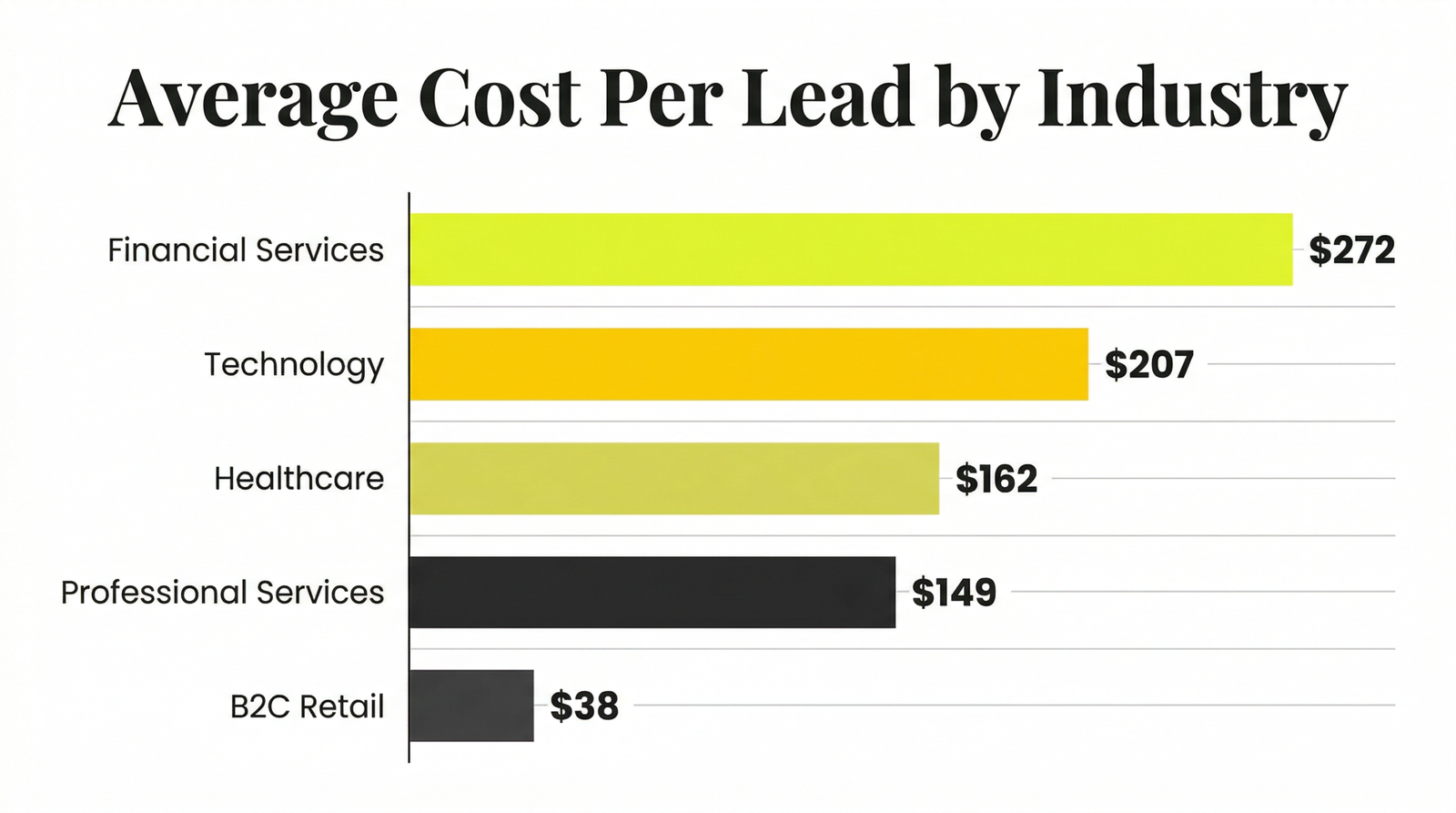
WordStream industry cost per lead data → wordstream.com
According to WordStream’s industry benchmarks, average cost per lead ranges from $38 in retail to $272 in financial services. These numbers reflect all lead generation channels, not just outsourced services, but they give a useful baseline for evaluating provider pricing.
B2C Lead Generation Companies: How They Differ From B2B
Most of the lead generation conversation centers on B2B, but B2C lead generation companies operate under very different conditions and use different methods.
In B2B, you are typically trying to reach a small number of highly specific decision-makers. Outreach is surgical. In B2C, you are reaching a much larger, more diverse audience. Volume matters more. The average deal value is lower, so cost per lead must be lower too.
B2C lead generation is heavily channel-dependent. Social media advertising (particularly Meta and TikTok), search advertising, and content marketing drive most B2C leads. Providers specializing in B2C typically have deep expertise in paid media, landing page optimization, and conversion rate optimization because those are the primary levers.
The lead qualification criteria in B2C are also simpler. For a home services company, a qualified lead might just be someone in a specific zip code who submitted a quote request. For a B2B SaaS company, qualification might involve company size, tech stack, and whether the contact has authority to approve a purchase.
If you are a B2C business, look specifically for providers with a documented track record in your vertical. A provider excellent at generating leads for B2B software companies will likely struggle with B2C insurance or home improvement leads.
Outsourced Lead Generation: When It Makes Sense, When It Doesn’t
Outsourced lead generation is not the right move for every business. Here is a practical framework for deciding.
It makes sense when your sales team is spending more than 30% of their time on prospecting rather than selling. Sales reps are expensive. Having them build lists, send cold emails, and follow up with unresponsive contacts is a poor use of their skills and your money. Outsourcing that function frees them to do what they are actually good at.
It makes sense when you are entering a new market and need pipeline fast. Building an in-house prospecting function takes months. Hiring a team, training them on your product and ICP, and getting them to ramp takes time you may not have. An outsourced team can start running campaigns within weeks.
It does not make sense when your product requires deep subject matter expertise to explain. Some products are so technical or niche that an external team simply cannot represent them convincingly. In those cases, you need at minimum a hybrid model where your internal experts handle qualification calls while an outsourced team handles top-of-funnel outreach.
It also does not make sense when you have not defined your ideal customer profile. Outsourced lead generation amplifies whatever targeting you give the provider. If you do not know who your best customers are, no provider can find more of them efficiently.
Contact us to discuss whether outsourced lead generation fits your situation →
Lead Generation and Appointment Setting: Why Bundling These Two Works
Lead generation and appointment setting are often treated as separate functions, but combining them under one provider produces better results than splitting them.
Here is why. When the same team that generates the lead also handles the follow-up and scheduling, there is no handoff gap. A lead generated by one team that then sits in a CRM waiting for a sales rep to make first contact loses warmth fast. Research from InsideSales (now XANT) found that leads contacted within five minutes of expressing interest are 9 times more likely to convert than leads contacted after 10 minutes.
When the lead generation company handles appointment setting too, response time drops dramatically because the same team that created the outreach owns the follow-through. The conversations are also warmer because the outreach agent already has context on what the lead responded to.
For B2B companies in particular, lead generation and appointment setting delivered as a combined service is often worth the premium. You trade a higher per-appointment cost for sales conversations that are pre-warmed and properly scheduled.
Commercial Lead Generation Services: What Makes Them Different
Commercial lead generation services is a term used in a few contexts, but it most commonly refers to lead generation for commercial real estate, construction, commercial services (like HVAC, electrical, or cleaning), and B2B professional services.
These sectors have some distinct characteristics. Purchase decisions are often made by a small committee rather than an individual. Deal cycles are longer. The relationship between buyer and seller often starts well before any formal inquiry.
Commercial lead generation in these sectors relies heavily on data quality. Getting the right contact at the right company at the right time depends on knowing who is currently in a buying cycle, which requires either ongoing list maintenance or access to intent data providers like Bombora or G2.
Providers specializing in commercial sectors typically build campaigns around a combination of account-based marketing (targeting specific companies), direct outreach, and in some cases, referral-based programs. Digital advertising alone rarely produces the lead quality commercial clients need because it attracts a broad audience that includes many contacts who are far from ready to buy.
White Label Lead Generation: A Growing Model for Agencies
If you run a digital marketing or growth agency, white label lead generation is worth understanding even if you are not actively selling it today.
The model works like this. You partner with a specialist lead generation provider. When your clients need lead generation, you scope the work, mark up the cost, and present the deliverables under your brand. The specialist does the operational work.
The advantage is margin without infrastructure. You can offer an additional service line without hiring specialized staff or building new tooling. The risk is that your client relationship depends partly on the quality of a third party’s work. If the white label provider underperforms, your agency takes the reputational hit.
Vetting your white label partner is therefore more important than vetting a provider you use for your own lead generation, because the consequences extend to your client relationships.
When evaluating white label providers, look for ones that offer dedicated account managers rather than shared support, provide unbranded reports that you can customize with your own branding, and have documented SLAs for lead quality and volume.
Explore our services and order options →
What the Best Lead Generation Companies Have in Common
After reviewing what separates average providers from genuinely good ones, a few consistent factors emerge.
They qualify leads using multiple signals, not just one. A contact who filled out a form is one thing. A contact who filled out a form, engaged with a follow-up email, and confirmed interest in a call is something much more valuable. The best lead gen companies use multi-touch sequences that filter out low-intent contacts before they reach your sales team.
They are transparent about lead sources. Good providers tell you exactly where leads came from, what actions they took, and what objections they raised (if any). This information helps your sales team tailor their approach and helps you evaluate which channels are producing the best results.
They measure cost per qualified lead, not just cost per lead. The distinction is significant. If a provider delivers 200 leads at $25 each but only 10 pass your sales team’s qualification criteria, your real cost per qualified lead is $500. A provider that delivers 50 leads at $80 each with an 80% qualification rate produces a real cost of $100 per qualified lead. The math makes the second provider dramatically better value.
They iterate based on data. Top lead generation companies do not run the same campaign for six months if the first month shows weak results. They test subject lines, outreach sequences, targeting parameters, and offer positioning. They bring those results to you with recommendations.
Read our complete guide to lead generation strategies that work in 2026 →
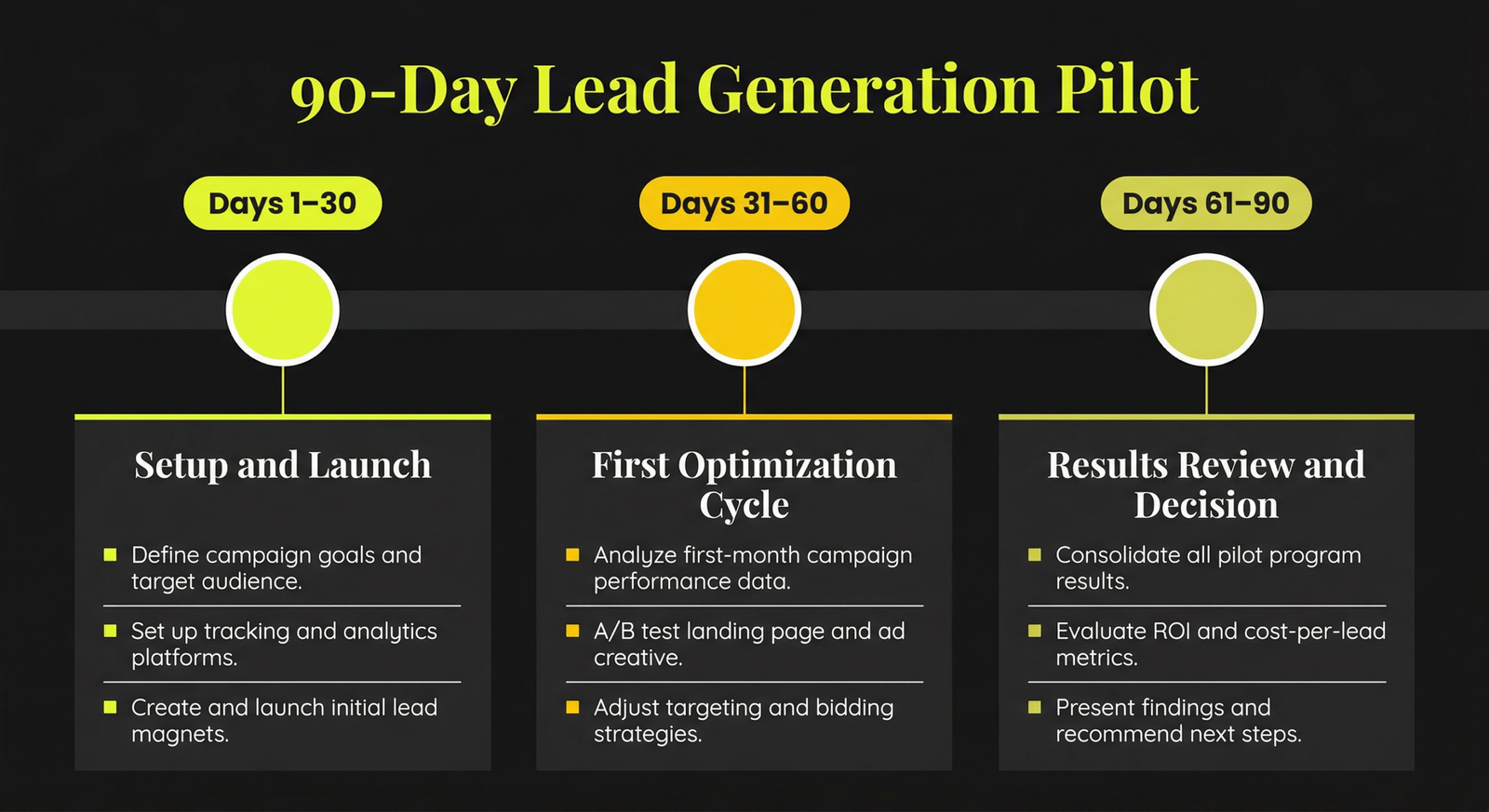
How to Run a Meaningful Pilot with Any Lead Generation Provider
Rather than committing to a long-term engagement upfront, structure a pilot that gives you real data within 60 to 90 days.
Define your success metrics before the pilot starts. What is an acceptable cost per qualified lead? What minimum volume do you need monthly to make the service worthwhile? What percentage of leads should convert to sales conversations?
Give the provider the information they need to succeed. This means a detailed ideal customer profile, clear messaging about your value proposition, honest information about objections your sales team commonly faces, and access to relevant case studies or proof points. Providers who underperform often do so because they received insufficient context, not because of a lack of capability.
Review results at 30 days. This is not to make a final decision, but to catch early signals. If open rates are too low, the targeting may be off. If leads are coming in but not converting to conversations, there may be a qualification mismatch. Catching these things at day 30 rather than day 90 saves a month of budget.
At the end of the pilot, compare actual results against your pre-defined success metrics. Make a go/no-go decision based on data, not on the relationship you have built with the account manager.
Affordable Lead Generation Services: What “Affordable” Actually Means
The word “affordable” is doing a lot of heavy lifting in most conversations about lead generation pricing. What affordable means depends entirely on your economics.
For a business selling a $500 product, paying $200 per qualified lead is almost certainly unsustainable. For a business selling a $50,000 service, paying $500 per qualified lead with a 20% close rate produces a $2,500 customer acquisition cost on a $50,000 deal, which is extremely favorable.
Before evaluating whether a service is affordable, calculate your maximum acceptable cost per qualified lead. Take your average deal size, multiply by your gross margin percentage, and then apply your expected close rate. That gives you the revenue generated per qualified lead. Your lead cost should sit well below that number.
If you sell a $5,000 service with a 60% margin and close 15% of qualified leads, each qualified lead generates $450 in gross margin on average. You probably want your cost per qualified lead to stay below $150 to $200, leaving enough margin to cover other costs of acquisition.
That calculation tells you what affordable actually means for your business, and it gives you a clear ceiling to negotiate from when talking to providers.
2026 Trends Shaping Lead Generation Services
A few developments in 2026 are changing how the best lead generation companies operate.
AI-assisted prospecting is now standard among serious providers. Tools like Clay, Apollo, and Instantly use AI to enrich contact data, personalize outreach at scale, and identify intent signals. Providers who are not using these tools are at a disadvantage in both efficiency and lead quality.
Privacy regulations are tightening globally. GDPR in Europe, CCPA in California, and similar regulations in other jurisdictions are changing what data providers can collect and how they can use it. This is making list-based email outreach more legally complex and pushing better providers toward permission-based channels and first-party data strategies.
Intent data is becoming a competitive differentiator. Rather than reaching out to everyone who fits an ideal customer profile, leading providers now prioritize contacts who are actively researching solutions in your category. Bombora, G2, and TechTarget all sell intent signals that tell you who is in-market right now. Providers who incorporate intent data into their targeting tend to produce leads with significantly higher close rates.
LinkedIn outreach has also matured substantially. The platform’s AI-powered ad targeting and its native lead generation forms make it one of the most reliable channels for B2B lead generation, though costs have risen as more advertisers compete for the same audiences.
Common Mistakes Businesses Make When Hiring Lead Generation Companies
Even sophisticated buyers make avoidable mistakes. Here are the ones that come up most often.
Not aligning sales and marketing before signing a provider. If your sales team does not trust the leads coming in from external sources, they will not work them properly. This creates a self-fulfilling failure: leads arrive, sales ignores them, lead quality appears poor, the service gets cancelled. Get your sales team involved in defining lead criteria before you start.
Choosing a provider based on price alone. The cheapest option in lead generation is almost never the best value. See the math above.
Not giving the provider enough runway. Three weeks is not enough time to evaluate most lead generation campaigns. Outbound sequences take time to generate responses. Content-driven lead generation takes months to build momentum. Define realistic timelines at the start.
Treating lead generation as a tap you can turn off and on. Campaigns build momentum over time. Pausing a campaign for two months and then restarting it means rebuilding from scratch. Lead generation works best as a sustained function, not a sporadic one.
Not feeding results back to the provider. If your sales team is marking certain leads as unqualified, that feedback should flow back to the lead generation team so they can adjust targeting. Most businesses do not do this systematically, and as a result, providers keep delivering similar leads instead of improving.
Choosing Between In-House and Outsourced Lead Generation: A Practical Comparison
Many businesses assume they will eventually build everything in-house. That may be right for some companies. For others, outsourced lead generation remains the better option indefinitely.
In-house lead generation gives you full control over the process, deep institutional knowledge, and better integration with your sales culture. The cost is high: a competent lead generation specialist in the US costs $60,000 to $90,000 per year in salary, plus benefits, tools, management overhead, and the 6 to 12 months it takes to get them fully productive.
Outsourced lead generation is faster to stand up, has a more predictable cost structure, and gives you access to a team with existing processes and tooling. The cost is a real number: you know what you are paying each month. The trade-off is less control and dependence on an external provider’s priorities and staff.
A hybrid model is often the practical answer for mid-market companies. An in-house manager owns strategy, defines ICP, reviews lead quality, and maintains the relationship with the outsourced team, while the external team handles execution. This gives you control where it matters most without the full cost of building an internal operation.
Frequently Asked Questions
Expert answers to common B2B lead generation questions
What are lead generation services and how do they work?
Lead generation services are external providers that identify, attract, and qualify potential customers on behalf of a business. They use a combination of outbound outreach, digital advertising, content marketing, and data sourcing to build a pipeline of contacts who have expressed some level of interest in a company’s product or service.
The provider then delivers those contacts, often with supporting information like company size, job title, and the specific action that triggered the lead classification, to the client’s sales team.
How much do lead generation services cost?
Cost varies significantly based on the service model and industry:
- Pay-per-lead pricing: $20 for basic B2C leads to over $400 for qualified B2B decision-makers in competitive industries
- Pay-per-appointment models: $150 to $600 per booked meeting
- Monthly retainer services: $1,500 for small business packages to $15,000+ for full-service enterprise programs
The most useful way to evaluate cost is to calculate your maximum acceptable cost per qualified lead based on your deal size, margin, and close rate.
What is the difference between pay per lead and pay per appointment?
Pay per lead means you pay when a contact meets a pre-agreed definition of a qualified lead, such as matching certain demographic or firmographic criteria and having taken a specific action like responding to an email or filling out a form.
Pay per appointment means you pay only when a lead has agreed to and scheduled a live meeting or call with your sales team.
Pay per appointment transfers more risk to the provider and typically costs more per unit, but delivers contacts who are further along in the buying process.
Are lead generation companies worth it for small businesses?
They can be, but small businesses need to be selective. The best lead generation companies for small businesses offer:
- Flexible contract terms
- Lower minimum volumes
- Combined lead generation and appointment setting
This ensures small sales teams are not overwhelmed with raw contacts that require significant follow-up.
Small businesses should avoid enterprise-focused providers who are not set up to work at lower volumes efficiently. Pilot programs with clear success metrics defined in advance are the best way to evaluate whether a provider will work for a specific small business context.
What is white label lead generation?
White label lead generation is a model where a specialist provider delivers lead generation services that a marketing or sales agency then resells to its clients under its own brand.
The end client does not know which company is doing the operational work. Agencies use white label arrangements to expand their service offering without hiring specialized internal staff.
The key risk is that the agency’s reputation depends on the white label provider’s performance, so vetting the provider carefully is important.
How do I evaluate whether a lead generation company is legitimate?
Look for providers who offer:
- Transparent reporting with access to raw campaign data
- References from clients in your industry with similar budgets
- Define ‘qualified lead’ in writing with specific criteria
- Flexible contract terms rather than long lock-in periods
- Documented processes for handling lead disputes
Be cautious of providers who:
- Promise guaranteed results without defining what those results mean
- Charge only after very long exclusivity periods
- Cannot explain exactly how they source and qualify leads
Ready to Implement These Strategies?
Get a custom B2B lead generation strategy for your Nigerian business
Final Thoughts: What Happens Next Matters More Than Picking the Right Provider
Most businesses spend a lot of time choosing a lead generation partner and then very little time managing the relationship after signing. The provider does not have full context on your sales process, your objection-handling, or what a truly ideal customer looks like from your team’s experience. That context transfers over time, but only if you actively communicate it.
Set up a monthly review call where your sales team shares which leads converted, which did not, and why. Use that data to update your ICP and adjust targeting criteria. Give your provider access to your sales outcomes, not just feedback on whether you liked the leads.
The businesses that get the most from outsourced lead generation treat it as an ongoing collaboration, not a vending machine. They share information, iterate on the criteria, and give providers enough runway to