According to Demand Gen Report’s 2024 B2B Buyer Behaviour Study, companies with a formally documented lead generation process are 60% more likely to hit revenue targets than those operating without one. That gap widens every year - and it explains why businesses that treat lead generation as a system consistently outperform those that treat it as a series of one-off campaigns.
Most guides treat lead generation like a checklist. Do this, then this, then that. But the reality is messier. What works for a SaaS company in San Francisco will not work for a professional services firm in Lagos, and pretending otherwise wastes everyone’s time. This guide focuses on what actually moves the needle, why certain approaches work, and how to build a system you can trust in 2026.
Most guides treat lead generation like a checklist. Do this, then this, then that. But the reality is messier. What works for a SaaS company in San Francisco will not work for a plumbing business in Lagos, and pretending otherwise wastes everyone’s time. This guide focuses on what actually moves the needle, why certain approaches work, and how to build a system you can trust.
TL;DR
- Lead generation is the process of attracting and capturing interest from potential buyers.
- The most effective lead generation strategies in 2026 combine content, paid ads, email, and automation.
- No single channel works alone. The businesses winning in 2026 are combining three or more channels into a coordinated system.
- Google Ads, LinkedIn, email, and local SEO are the highest-ROI channels depending on your business type.
- Automation reduces lead response time from hours to minutes, which directly increases conversion rates.
- For B2B companies, booking a consultation is often the best first conversion goal, not a sale.
What Lead Generation Actually Is (And What It Isn’t)
Before getting into tactics, let’s be clear on the definition. Lead generation is the process of identifying people who have some interest in what you sell, and collecting their contact information so you can follow up. That’s it.
A lead is not a customer. It’s not even a guaranteed conversation. It’s a signal of potential interest, and your job after capturing that signal is to turn it into a real relationship.
The confusion between lead generation and sales is one of the most expensive mistakes B2B companies make. Marketing lead generation is about filling the top and middle of the funnel. Sales lead generation is about converting those contacts into paying clients. These are different jobs, they require different skills, and blending them without a clear handoff process is how pipelines get broken.
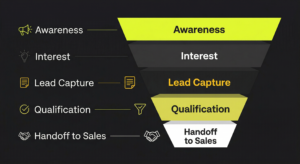
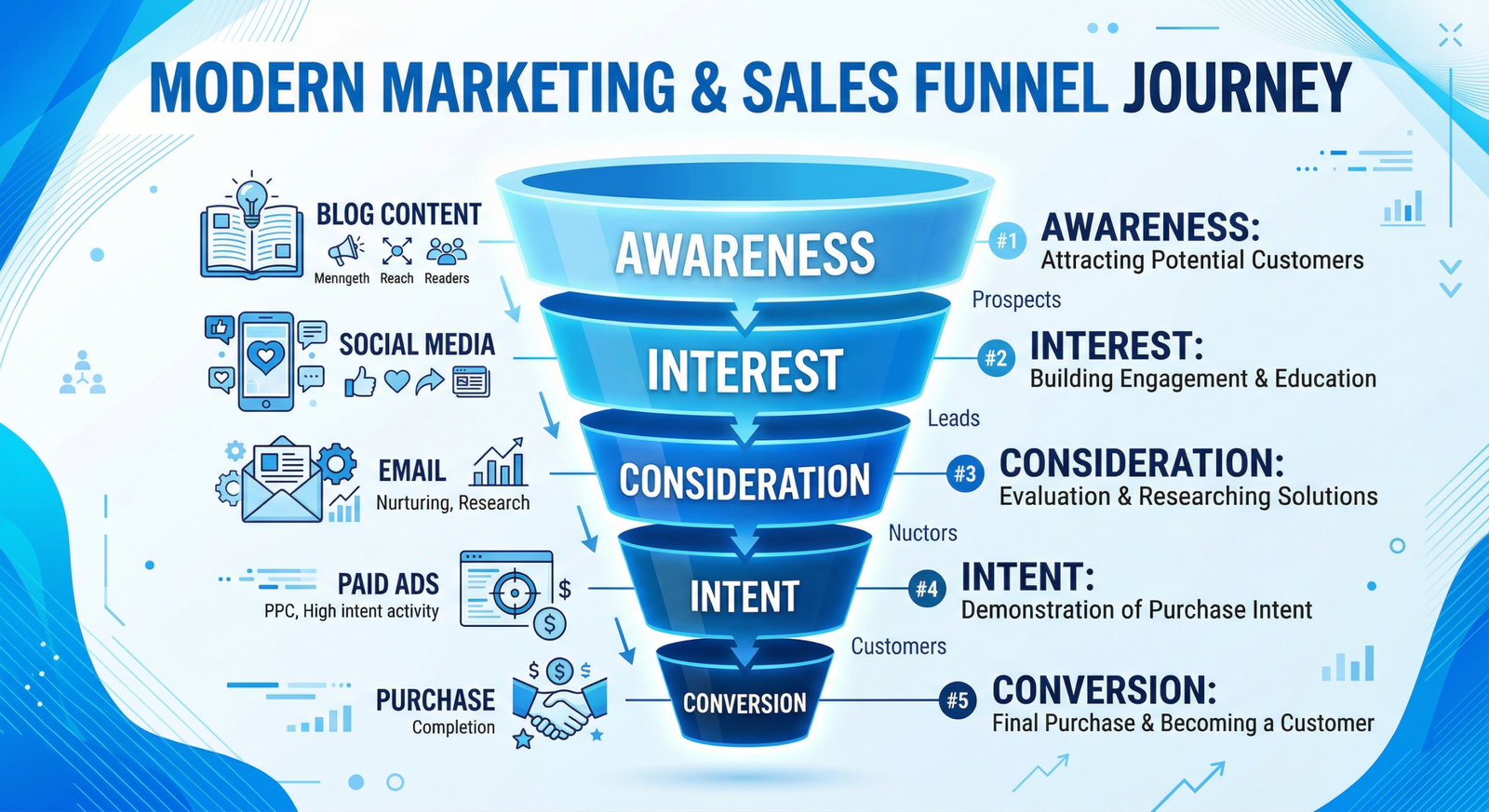
The lead generation process has five core stages:
- Attract: Get the right people to notice you
- Capture: Give them a reason to share their contact information
- Nurture: Build enough trust that they want to talk
- Qualify: Confirm they are a fit before your sales team invests time
- Convert: Turn a qualified lead into a customer
Every strategy in this guide maps to one or more of these stages. If you understand which stage a tactic serves, you can make smarter decisions about where to invest.
7 Lead Generation Strategies That Are Working Right Now
1. Content Marketing That Solves Specific Problems
Content has been a staple of online lead generation for over a decade, but the approach that worked in 2018 is not working in 2026. Publishing generic “10 tips” articles no longer builds authority or drives traffic in any meaningful volume.
What does work: content built around specific, high-intent searches from people who are actively trying to solve a problem you can fix.
HubSpot’s State of Marketing Report →
According to HubSpot’s 2026 State of Marketing Report, companies that publish 16 or more blog posts per month get 3.5 times more traffic than those publishing four or fewer. But traffic alone is not the goal. The metric that matters is how many of those visitors convert to leads by downloading a guide, booking a call, or subscribing to an email list.
The best content for digital marketing leads in 2026 is:
- Long-form guides that answer a question completely (like this one)
- Case studies with real numbers showing outcomes
- Comparison pages that help buyers choose between options
- Free tools, calculators, or templates that require an email to access
That last category, often called lead magnets, is particularly effective because it trades value for contact information. A construction company offering a free project cost calculator will collect emails from people who are actively planning projects. That’s a warm lead, not a cold one.
2. Email Lead Generation: Still the Highest ROI Channel
Email generates $36 for every $1 spent, according to the Data and Marketing Association. No other channel comes close consistently at scale.
Email lead generation works in two directions. The first is building your own list and nurturing people over time until they’re ready to buy. The second is outbound email, where you contact people who haven’t heard of you yet.
Both approaches work. They just require different tools and different skill sets.
For list building, the formula is:
- A lead magnet that attracts the right audience
- A landing page with a clear, singular call to action
- An automated welcome sequence that delivers the promised value and introduces your company
- An ongoing email newsletter that keeps you in front of people without being annoying
The automation piece is where most companies underinvest. When someone downloads your guide at 11pm on a Saturday, they should receive a confirmation and the content immediately, not when someone remembers to check the form submissions on Monday morning. That gap in response time kills momentum.
Mailchimp Email Marketing Benchmarks →
For outbound email, the rules are stricter. Spam regulations like GDPR in Europe and the CAN-SPAM Act in the United States require genuine consent and clear opt-out options. Beyond compliance, the practical reality is that cold email only works when it’s highly personalized, sent in low volumes to well-researched contacts, and offers something genuinely relevant.
Spray-and-pray cold email is not a strategy. It’s a way to get your domain blacklisted.
3. Google Ads Lead Generation: The Fastest Way to Get in Front of Buyers
If you need leads this week rather than this quarter, Google Ads is where you should start. The reason is intent. People searching “B2B marketing agency Lagos” or “commercial cleaning service London” are not browsing. They’re shopping.
Google Ads lead generation captures that intent at exactly the right moment.
The average Google Ads conversion rate across all industries sits around 4.4% for search campaigns, according to WordStream’s 2024 industry benchmarks. That number varies widely by industry, from under 2% in highly competitive spaces to over 10% in certain local service categories. But even at 4%, if 100 people click your ad, four of them turn into leads. At scale, that math works well.
Three things separate profitable Google Ads campaigns from expensive ones:
First, match the ad to the exact search term. “Commercial property management company” is not the same as “property management software.” Running the same ad for both will waste your budget.
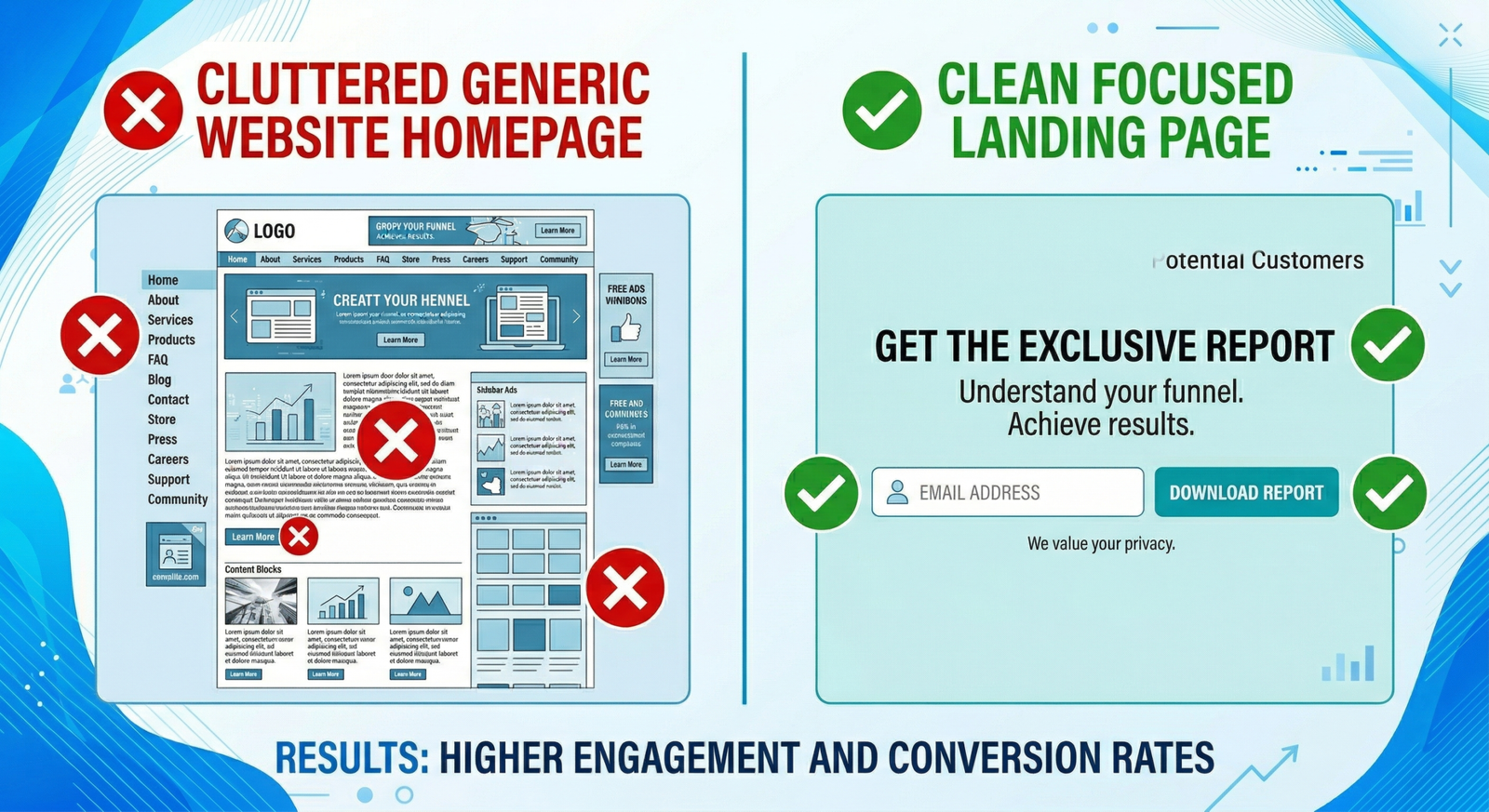
Second, send traffic to a dedicated landing page, not your homepage. The landing page should have one job: collect a name and email, or get a phone call. Menus, links to your blog, and other distractions lower conversion rates.
Third, use lead form extensions. Google allows you to embed a simple contact form directly in the ad, so users never even have to visit your website. For mobile users especially, this removes friction and increases submissions significantly.
4. Social Media Lead Generation: Where to Focus in 2026
Social media lead generation is real, but it’s also deeply misunderstood. The mistake most businesses make is choosing platforms based on personal preference or where their team is already comfortable, rather than where their buyers actually spend time.
Here’s the honest breakdown by platform:
LinkedIn is the most effective channel for B2B lead generation by a significant margin. A 2023 study by LinkedIn’s own marketing solutions team found that 80% of B2B leads from social media come from LinkedIn. The platform’s targeting options are unmatched for professional audiences. You can reach people by job title, company size, industry, seniority, and geography all at once.
Facebook remains the best option for local service businesses and consumer-facing B2B companies because of the sheer size of the audience and the precision of its interest-based targeting. For businesses offering local lead generation services, Facebook’s local awareness ads can be highly cost-effective.
Instagram and TikTok generate attention and brand recognition, but they convert to leads at lower rates unless your product is visual or your audience skews young. They’re not bad channels for B2B, but they’re rarely the primary lead generation channel.
X (formerly Twitter) has declined in advertiser effectiveness since 2022 and is now a secondary channel at best for most B2B advertisers.
The most effective social media approach in 2026 combines organic posting for authority-building with paid advertising for lead capture. Organic content builds trust over time. Paid ads accelerate that process for people who need what you offer right now.
5. Local Lead Generation: Getting Found by the Buyers Near You
Local lead generation is different from other approaches because proximity matters. A person searching “accountant near me” or “digital marketing agency Abuja” is not looking for the global best option. They want someone local, accessible, and ideally with reviews they can read.
Three tactics drive the majority of local leads online:
Google Business Profile optimization is the single highest-ROI activity for any business with a physical location or a defined service area. A fully optimized profile, with accurate hours, services, photos, and recent reviews, can generate dozens of inbound service leads per month at zero ongoing cost.
Local SEO, meaning optimizing your website to rank for location-specific search terms, builds on your Google Business Profile and creates long-term organic traffic. This takes three to six months to produce results, but those results are durable.
Review generation is often overlooked, but it’s a direct ranking factor in local search. Businesses with more recent, positive reviews consistently rank above competitors with fewer or older reviews. The simplest system: after completing a job, send a text or email with a direct link to your Google review page and ask the customer to share their experience.
6. Automated Lead Generation: Building a System That Works Without You
This is where most businesses get excited but most implementation falls apart. Automated lead generation is not a single tool. It’s a system of connected tools that together move a person from stranger to qualified lead without requiring a human to intervene at every step.
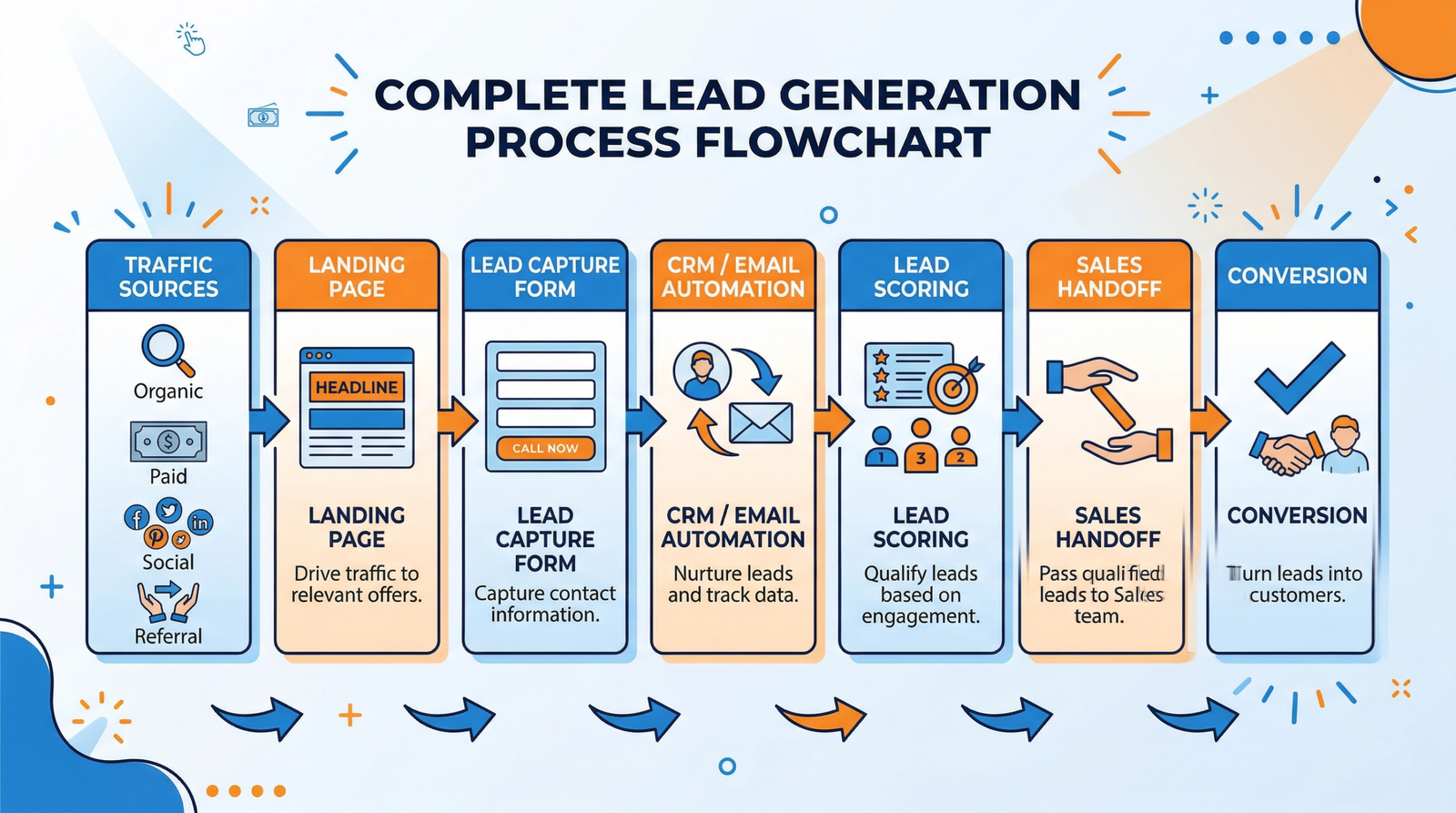
A functional automated lead generation system includes:
- Traffic sources (ads, SEO, social media) sending people to a landing page
- A lead capture form connected to your CRM
- An immediate automated email or SMS confirmation
- A drip email sequence that delivers value over days or weeks
- Lead scoring that alerts your sales team when a lead reaches a threshold of engagement
- A CRM task that assigns a follow-up call to a specific sales rep
According to a Salesforce report, companies that use marketing automation see 53% higher conversion rates from initial lead to qualified opportunity than companies that don’t. The reason is simple: speed and consistency. An automated system follows up within minutes, every time, without forgetting.
Salesforce State of Sales Report →
The tools that power this system vary by budget and scale. For small businesses, Mailchimp or ActiveCampaign plus a basic CRM like HubSpot Free covers most of what’s needed. For larger operations, platforms like Salesforce, Marketo, or Pardot offer more sophisticated scoring and routing.
The honest caveat: automation does not replace the need for good content and genuine value. If your lead magnet is weak, your emails will get ignored. If your landing page is confusing, your forms won’t get filled. Automation makes a good system faster. It cannot fix a bad one.
7. Inbound Lead Generation: Attracting Buyers Who Come to You
Inbound service leads are leads that come to you because they’ve seen your content, heard about you from someone they trust, or found you through search. These leads are almost always higher quality than outbound leads because the person has already demonstrated interest before you’ve spent a dollar talking to them.
The foundation of inbound is being genuinely useful in public. That means:
- Writing content that answers the questions your buyers are already searching
- Being active and specific in industry conversations online
- Building a reputation through client results, case studies, and testimonials
- Making it easy for referrals to happen by giving existing clients the tools to share your work
Inbound marketing lead generation takes longer to produce results than paid ads. The trade-off is that inbound leads are typically cheaper to acquire over time, more likely to convert, and more likely to become long-term customers.
The businesses that win at inbound are not the ones with the biggest budgets. They’re the ones with the most consistent output. Publishing one genuinely useful article per week for two years will build a traffic base that paid ads cannot replicate for any reasonable cost.
Contact us to discuss your inbound strategy →
Building Your Lead Generation Process: A Practical Framework
Understanding individual tactics is useful. Building them into a coherent process is what actually generates consistent revenue.
Here’s how to build a lead generation process that works in practice, not just on a slide deck:
Step one is to define your ideal customer profile precisely. Not “small businesses” but “family-owned manufacturing companies in the southeast with 20 to 100 employees that sell to retail distributors.” The more specific your definition, the better every other decision becomes.
Step two is to choose two or three channels where your ideal customer is reachable and where your budget allows consistent investment. Spreading budget across six channels with thin coverage produces worse results than concentrating on three channels done well.
Step three is to build a lead magnet that is directly relevant to the problem your ideal customer is trying to solve right now. Not a general guide about your industry. A specific, practical resource about the exact problem driving them to search.
Step four is to set up capture and automation before running any traffic. Spending money driving people to a page with no form, or having a form with no follow-up sequence, is a common and expensive mistake.
Step five is to define what a qualified lead looks like before the sales team gets involved. If sales reps are spending time on leads that were never going to buy, the whole system breaks down. Document the criteria and build them into your lead scoring.
Step six is to track conversion at every stage and review the numbers weekly. If a hundred people visit your landing page and only two fill out the form, the page is the problem. If fifty people fill out the form but none of them show up to the consultation call, the follow-up sequence is the problem. The numbers tell you exactly where to fix things.
Lead Generation Digital Marketing: What the Data Says About Channel Performance
Choosing where to invest depends heavily on your industry, budget, and sales cycle. But there is enough data now to make informed comparisons.
Semrush State of Content Marketing Report →
For B2B companies with sales cycles longer than 30 days, the highest-performing combination in 2024 was content SEO plus LinkedIn advertising plus email nurturing. According to Demand Gen Report’s 2024 B2B Buyer Survey, 68% of B2B buyers prefer to research options independently before engaging with a sales rep. Content that appears in their organic search results during that research phase is what gets them into your funnel.
For local service businesses, Google search ads and Google Business Profile are consistently the top two performers. A local plumber, accountant, or marketing agency typically sees more return from these two channels than from any other combination.
For e-commerce adjacent B2B companies, where the transaction can happen online without a sales call, Google Shopping, Meta retargeting, and email sequences remain the core stack.
The channel that consistently underperforms its hype is organic social media. Posting on LinkedIn or Facebook without paid amplification reaches a shrinking percentage of followers and produces minimal new leads. It has value for relationship maintenance and brand familiarity, but it’s not a lead generation engine on its own.
Sales Lead Generation: How Marketing and Sales Should Actually Work Together
The disconnect between marketing and sales is one of the oldest problems in business. Marketing says sales won’t follow up on the leads. Sales says the leads marketing sends are garbage. Both are often partially right.
A well-designed sales lead generation system addresses this with three structural agreements:
First, a shared definition of a qualified lead. Both teams agree on exactly what criteria make someone worth a sales conversation. This definition is written down, not informal.
Second, a service level agreement on follow-up timing. If marketing delivers a qualified lead, sales agrees to make first contact within a defined window, typically 24 hours or less. Research from MIT’s Lead Response Management study found that contacting a lead within the first hour of submission makes conversion 7 times more likely than waiting even one additional hour.
Third, a feedback loop where sales reports back to marketing on lead quality. If sales is consistently finding that leads from a specific campaign are not converting, marketing needs that information to adjust targeting or messaging. Without the feedback loop, bad campaigns run indefinitely.
Common Lead Generation Mistakes That Waste Budget
After building lead generation systems for companies across multiple industries, I’ve seen the same mistakes repeatedly. These are the ones that cost real money.
Sending paid traffic to your homepage is the most expensive and common error. Your homepage is designed to explain your company to anyone. Your landing page should be designed to get one specific type of person to take one specific action. The difference in conversion rate is usually 3x to 5x.
Not following up fast enough kills more deals than bad pitches do. Most companies wait 24 hours or more to respond to an online inquiry. By that point, the person has likely already contacted a competitor who responded faster.
Optimizing for lead volume instead of lead quality produces sales teams drowning in conversations that go nowhere. Adding one qualifying question to your lead form, like company size or monthly budget, can reduce volume by 30% while improving close rate by more than that.
Stopping too early is the mistake that most harms long-term results. SEO takes six months to twelve months to show significant results. Email lists take time to build. Paid ads take weeks of optimization to become profitable. Companies that quit after sixty days and declare that “content marketing doesn’t work” have simply not waited long enough.
Ignoring the post-conversion experience means that even customers who buy once don’t become repeat buyers or referral sources. The lead generation process doesn’t end at the first sale. Your happiest customers are your cheapest future leads.
How to Measure Whether Your Lead Generation Is Working
Numbers you should track every week, in order of importance:
Cost per lead by channel. This tells you where your budget is working hardest. A lead from Google Ads that costs $40 might be better value than a lead from a trade show that costs $400.
Lead-to-opportunity rate. Of everyone who submits a form, how many become real sales conversations? If this number is low, either your targeting is wrong or your form is too easy to fill out casually.
Opportunity-to-close rate. Of everyone who enters a sales conversation, how many buy? If this number is low, the problem is in the sales process or in the quality of leads being passed to sales.
Time to first contact. How long after a lead submits their information does someone from your team reach out? This should be under one hour for high-intent leads.
Customer acquisition cost by channel. Taking the total cost of a channel divided by the number of customers it produced. This is the number that tells you whether to scale up or cut a channel.
2026-Specific Developments Changing Lead Generation
Three developments are reshaping how lead generation works right now.
AI-assisted personalization at scale has become accessible to mid-market companies, not just enterprise ones. Tools like Clay, Apollo, and Instantly allow sales teams to research leads and personalize outreach in ways that previously required hours of manual work per prospect. The result is that cold outreach is becoming more effective for companies that use these tools correctly, even as generic spam becomes easier to filter.
Zero-click search, where Google answers queries directly in the search results without users visiting any website, is reducing organic traffic to informational content. The response is to focus on content that requires more depth than Google can answer in a snippet, and to emphasize email list building so you own your audience rather than renting visibility from search engines.
Privacy changes, including the decline of third-party cookies and increased adoption of iOS privacy protections, have made retargeting less precise than it was in 2020. First-party data, meaning information collected directly from people who interact with your business, has become the most valuable asset in digital marketing. Building your email list is not just a lead generation strategy. It’s a hedge against platform changes you cannot control.
Putting It Together: What a Real Lead Generation System Looks Like
To make this concrete, here’s what a working lead generation system looks like for a B2B services company targeting mid-size Nigerian businesses.
Traffic comes from three sources: organic search for industry-specific topics, LinkedIn ads targeting operations managers and directors at companies with 50 or more employees, and retargeting ads for people who visited the website but didn’t convert.
All traffic goes to a dedicated landing page offering a free 30-minute strategy session or a downloadable guide relevant to the target audience’s specific problem.
Form submissions trigger an immediate email confirmation with the promised resource, followed by a five-email nurture sequence over 14 days that shares relevant case studies and answers common objections.
The CRM tracks how many emails each lead opens. Leads who open three or more emails within 14 days get flagged as high-intent, and a sales rep receives a task to make personal contact within 24 hours.
Every week, the marketing team reviews cost per lead by source, form conversion rate, and lead-to-call rate. Changes are made based on data, not instinct.
This is not complicated. But it requires setting up all the pieces before launching, not building them one at a time while the campaign is already running.
Start with a B2B Consultation →
Frequently Asked Questions
Expert answers to common B2B lead generation questions
What are the most effective lead generation strategies in 2026?
The most effective lead generation strategies in 2026 combine content marketing, Google Ads, email nurturing, and LinkedIn advertising for B2B companies. Local businesses get the best results from Google Business Profile optimization and local search ads.
The common thread across successful strategies is speed: fast follow-up with new leads, fast page load times, and fast delivery of promised resources. Using two to three channels in a coordinated system consistently outperforms relying on a single channel.
How long does lead generation take to produce results?
Paid channels like Google Ads and LinkedIn Ads can produce leads within days of launching a campaign, assuming the landing page and offer are well-built.
Content SEO typically takes three to six months to generate meaningful organic traffic, and six to twelve months to reach competitive rankings.
Email marketing produces results from the first campaign sent to an existing list, but building that list from scratch takes time.
Most businesses see meaningful results from a combined inbound and paid strategy within 90 days of consistent execution.
What is the difference between marketing lead generation and sales lead generation?
Marketing lead generation focuses on attracting and capturing potential buyers, typically at the top and middle of the sales funnel. This includes content creation, paid advertising, email campaigns, and social media.
Sales lead generation focuses on converting those captured contacts into actual customers through direct outreach, follow-up calls, and closing conversations.
The two functions overlap, but they require different skills and are measured by different metrics. Marketing is measured by cost per lead and lead quality. Sales is measured by close rate and revenue generated.
How much does lead generation cost?
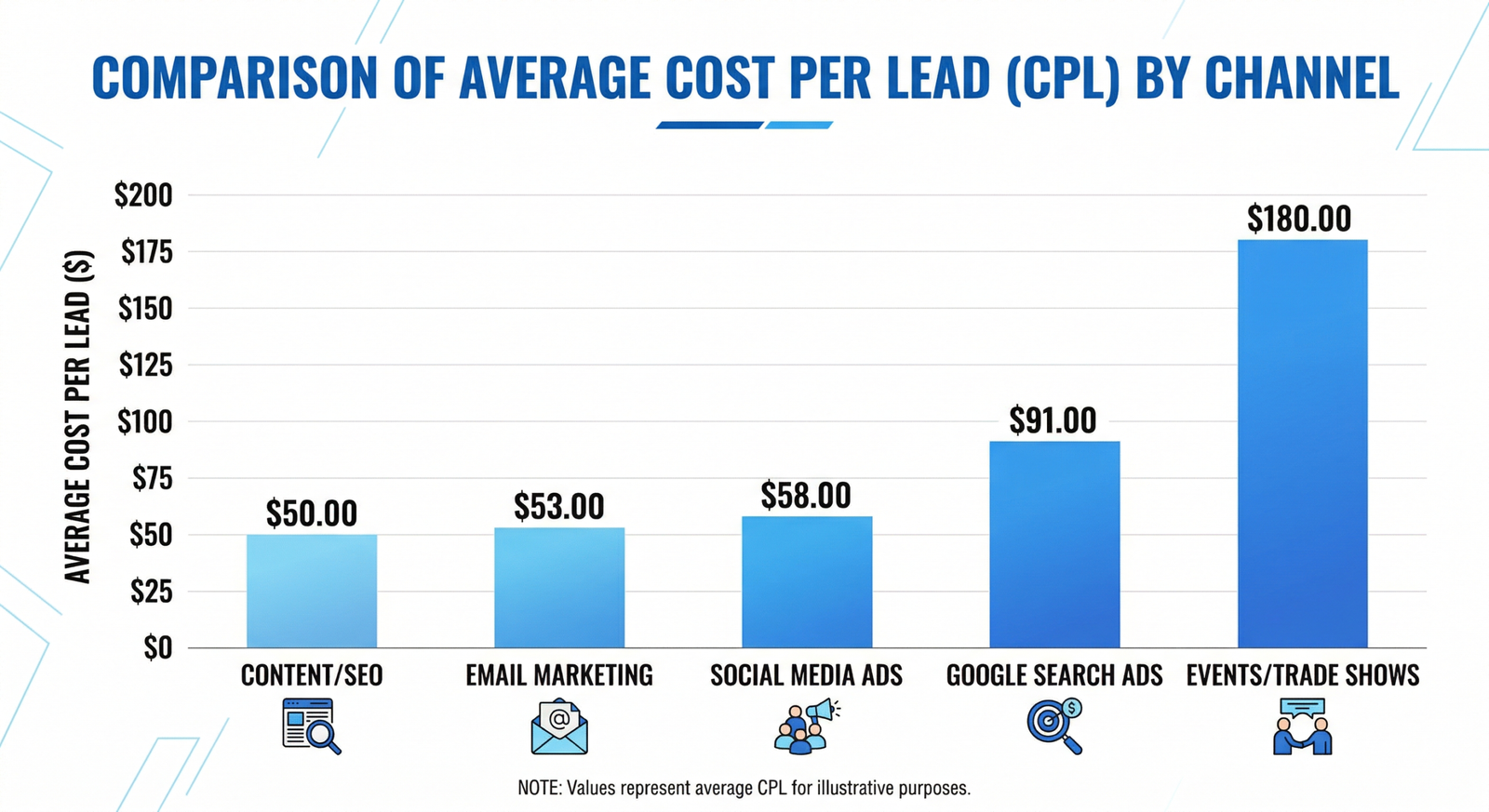
Cost per lead varies significantly by industry and channel. According to industry benchmarks:
- Content and SEO: Around $50 per lead
- Email marketing: Around $53 per lead
- Social media ads: Around $58 per lead
- Google search ads: Around $91 per lead
- Trade shows and events: $180+ per lead
B2B leads in competitive industries with long sales cycles can cost $200 to $500 per lead through paid channels and still represent positive ROI when the lifetime value of a customer is high.
What is automated lead generation and does it work?
Automated lead generation uses connected software tools to capture, follow up with, and qualify leads without requiring manual effort at each step. It typically includes:
- Automated email sequences triggered by form submissions
- Lead scoring based on behavior
- CRM tasks assigned to sales reps when a lead reaches a defined threshold
It works - Salesforce reports that companies using marketing automation see 53% higher conversion rates from lead to opportunity.
The important caveat: automation makes a good system faster. It cannot fix weak content, poor targeting, or an irrelevant offer.
Which social media platform is best for B2B lead generation?
LinkedIn is the most effective social media platform for B2B lead generation, with 80% of B2B social media leads originating from LinkedIn according to LinkedIn’s marketing research.
Its targeting options allow advertisers to reach specific job titles, company sizes, industries, and seniority levels simultaneously, which is not possible on most other platforms.
Facebook is the better option for local service businesses and consumer-facing B2B companies due to its audience size and interest-based targeting.
Instagram and TikTok generate awareness effectively but convert to leads at lower rates for most B2B categories.
Ready to Implement These Strategies?
Get a custom B2B lead generation strategy for your Nigerian business
Final Thoughts: Where to Start
Most people reading a guide like this already know what they should be doing. The gap isn’t information. It’s deciding which two or three things to actually start this month and then staying consistent long enough to see results.
If you’re starting from zero, the sequence that works for most B2B companies is: build a lead magnet and landing page first, set up your email automation second, then drive paid traffic while your organic content builds in the background. That order matters because it means you have a system to capture leads before you spend money driving traffic.
If you already have traffic but aren’t converting it, the landing page and follow-up speed are where to look first.
If your leads are converting to conversations but not to customers, the problem is in sales qualification or pricing, not lead generation.
Ready to build your lead generation system? Visit our homepage →
The businesses that win at lead generation in 2026 are not the ones with the largest budgets. They’re the ones who know exactly who they’re trying to reach, have something genuinely useful to offer that person, and follow up fast when that person raises their hand. Build those three things correctly, and the specific channels you use matter a lot less than you think.
This article reflects current best practices and platform data as of mid-2026. Channel performance and costs shift regularly, so treat specific numbers as directional benchmarks rather than guarantees.